Moy Yat Talks (Fan Sao, San Sao, Sifu)
by Moy Yat
Get Moy Yat Talks (Fan Sao, San Sao, Sifu) by Moy Yat Digital Download!
You can check proof of content here

Download immediately Moy Yat Talks (Fan Sao, San Sao, Sifu) by Moy Yat
Overview
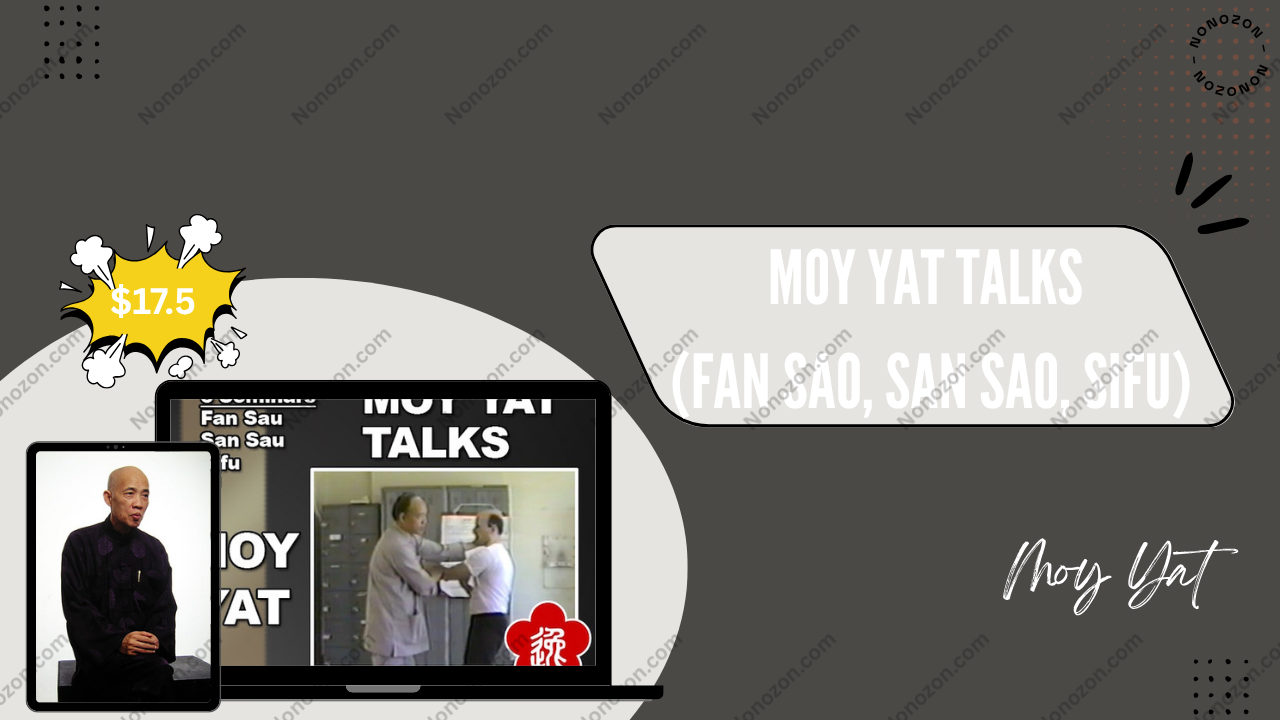
Moy Yat Talks (Fan Sao, San Sao, Sifu): A Timeless Exploration of Wing Chun's Deeper Dimensions
Released on June 16, 1990, Moy Yat Talks (Fan Sao, San Sao, Sifu) is more than a historical artifact of Wing Chun instruction—it's a profound exploration of the art’s inner workings. Over the course of two hours, the late Grandmaster Moy Yat delivers a layered, multidimensional presentation that merges live demonstration, philosophical dialogue, and conceptual dissection. The result is a uniquely valuable guide for martial artists seeking not only to improve technique, but to better understand the logic and culture behind their movements.
What sets this video apart is how effectively it links principle to practice. Whether you're new to Wing Chun or have trained for years, the lessons here will challenge assumptions and deepen your engagement with the art.
Divided into three core themes—Fan Sao, San Sao, and Sifu—the presentation offers a framework for examining how strategy, adaptability, and interpersonal dynamics shape martial practice. Each section builds on the last, creating a cohesive blueprint for refining both mindset and method.
Fan Sao: The Concept of Completion in Combat
The first section introduces Fan Sao, often translated as “returning hand” or “completing hand.” But rather than treat this as a singular technique, Moy Yat elevates it to a principle—one that speaks to the idea of completion in combat. He emphasizes that martial effectiveness doesn’t come from isolated strikes, but from the ability to finish a movement with clarity and purpose.
Rather than rigidly following a pre-set technique, practitioners are urged to adapt in the moment. In real combat, not every strike lands cleanly; not every sequence goes as planned. The lesson here is clear: your ability to recognize that a moment has shifted—and to complete your technique in light of that shift—is what defines high-level skill.
Moy Yat underscores the need for flexibility without chaos. Strategy matters, but so does instinct. Fan Sao, as he describes it, is the ability to transition fluidly from one opportunity to the next—an essential trait for any serious martial artist.
San Sao: The Reality of Applied Fighting
The second segment, focused on San Sao (loosely translated as "separate hands" or free application), drills into the practical application of Wing Chun in unpredictable settings. Moy Yat challenges the sanitized nature of many martial arts training routines, warning against the illusion that mastery comes from repetitive, pattern-based drills alone.
Here, he redefines what “effective technique” truly means: not something that looks good in a classroom, but something that works under pressure. He discourages blind adherence to choreography and pushes instead for responsive, dynamic training environments that mimic the stress and spontaneity of real-world conflict.
Moy Yat also reminds students that critical thinking is an essential tool in their arsenal. Rather than simply ask, “Did the technique look right?” he encourages deeper inquiry: Did it serve its purpose? Could it be improved? Was it the best choice in that moment?
This portion of the talk is especially relevant for instructors and advanced students. It calls into question the value of rote learning and champions a more holistic, thoughtful approach to martial arts development.
Chi Sao and the Role of the Sifu: Interactive Learning and Lineage
In the final portion of the presentation—partially led by one of Moy Yat’s students—the discussion shifts toward Chi Sao and the broader role of the Sifu (teacher). This segment ties together the earlier lessons on adaptability and realistic application by exploring how these principles play out in partnered practice.
Chi Sao or “sticking hands” is one of Wing Chun’s most distinctive training methods, aimed at developing tactile sensitivity, timing, and reflex. But in Moy Yat’s approach, Chi Sao isn’t just a drill—it’s a communication tool. It's the laboratory where Fan Sao and San Sao are stress-tested, refined, and internalized through interactive feedback.
Through Chi Sao, practitioners learn to sense intention, adjust position, and respond without hesitation—all without brute force. It’s here that Wing Chun’s strategic and energetic principles come to life. Students aren’t just executing techniques; they’re listening through movement, building relational awareness that carries into real combat.
The inclusion of the Sifu discussion underscores another vital theme: that martial growth doesn’t happen in isolation. A good teacher facilitates discovery rather than enforcing dogma, encouraging students to engage critically and explore the art’s concepts for themselves. In this way, the video not only teaches technique—it models a pedagogy.
Technical Aspects and Enduring Legacy
Although originally captured on VHS, and thus bearing the production limitations of its time, the clarity of Moy Yat’s presentation makes the dated format largely irrelevant. The audio is crisp enough to follow, and the demonstrations—while simple in staging—are delivered with such precision and insight that they transcend technical shortcomings.
The video’s influence has endured for decades. It is still cited by instructors and included in advanced curricula across multiple Wing Chun lineages. The ideas presented remain current, even as training methods evolve. That’s the mark of true martial wisdom: it doesn’t age—it deepens.
For beginners, the accessible structure makes complex ideas easier to grasp. For experienced practitioners, the layered discussion offers a mirror for self-reflection and recalibration. Whether you're revisiting the basics or testing your philosophy against practical performance, Moy Yat Talks offers something substantial.
Core Lessons and Takeaways
Here’s a concise breakdown of the key insights from each section:
| Section | Insight |
|---|---|
| Fan Sao | Completion is key—adaptability and timing ensure decisive technique. |
| San Sao | Real fighting is unpredictable—train with realism and strategic depth. |
| Chi Sao | Sensitivity and engagement are vital—respond, don’t just react. |
| Sifu | True instruction inspires inquiry—lineage is about guidance, not hierarchy. |
This holistic structure—blending physical, conceptual, and interpersonal dynamics—captures the richness of Wing Chun as both an art and a way of thinking.
Final Thoughts: A Masterclass in Timeless Martial Thinking
Moy Yat Talks (Fan Sao, San Sao, Sifu) stands as one of the most comprehensive and thoughtful video resources available on Wing Chun. With its blend of technical demonstration, philosophical inquiry, and pedagogical insight, it reaches far beyond the scope of most martial arts instructionals.
Moy Yat doesn’t simply teach moves—he teaches how to think like a martial artist. He invites practitioners to question assumptions, engage with intention, and cultivate a mindset of continuous growth.
Whether you’re a beginner looking for guidance or a veteran seeking refinement, this video will deepen your appreciation of Wing Chun’s core truths. It’s not just about fighting. It’s about learning how to learn. And in that sense, this resource is as valuable today as it was the day it was recorded.